Lugano, November 11, 2026. Today, we announce the general availability of Natzka AI, the Enterprise AI Framework built on the Natzka decision platform. Natzka AI is available in all markets, and existing and future customers get it as part of the platform.
Natzka AI gives LLMs an understanding of how the business works: which figures count, which rules apply, and who may see what. As a result, answers rest on the company’s actual data and business logic, not on general knowledge.
Why we built it
The next phase of AI transformation will be measured by its impact on the business: the value it creates, the decisions it improves and the actions it enables. That requires AI to understand the company as a whole: its data, its processes and the people responsible for results,” says Matteo Emiliani, our CEO. “We built Natzka to provide those foundations. With Natzka AI, we empower people across the organisation to understand what is happening, make better decisions and turn them into coordinated action through a simple, intuitive experience. This is how AI becomes part of how a company operates.
In this short video, our CEO Matteo Emiliani explains the thinking behind Natzka AI.
Business questions, answered in seconds
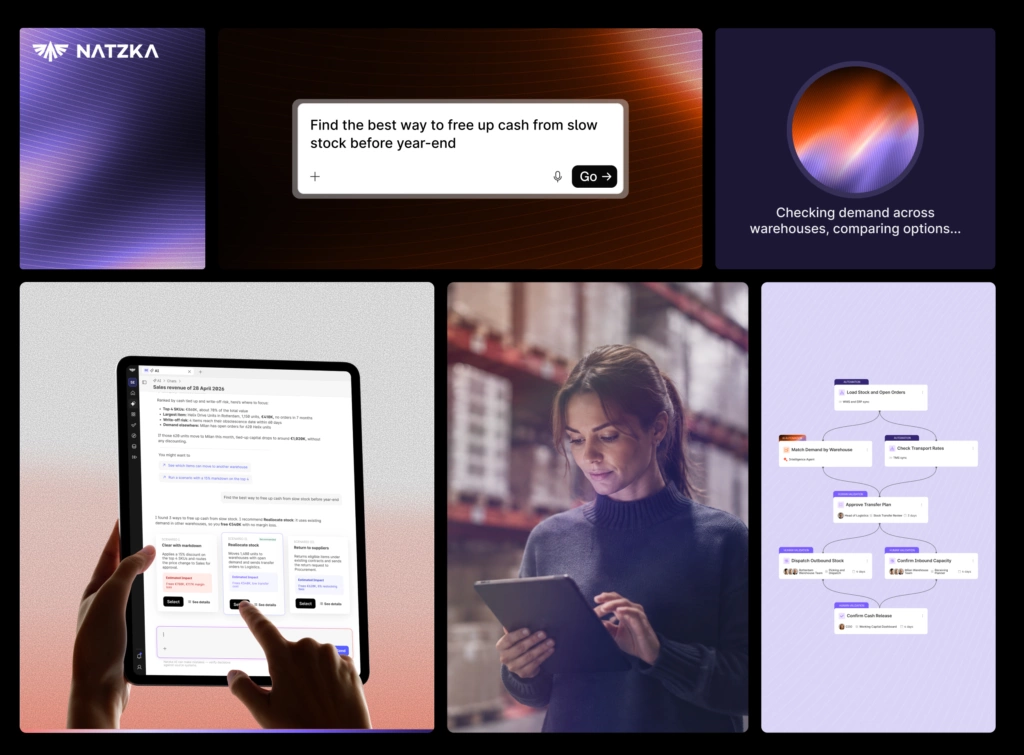
Take a question many finance and operations teams face at the end of the year. How can we free up cash tied up in slow-moving stock before year-end? Usually, the answer means pulling stock levels from one system and demand data from another. Then someone has to reconcile the figures across departments.
With Natzka AI, a manager simply asks the question in plain language. The framework checks demand across warehouses and compares options such as reallocating stock, a targeted markdown, or returns to suppliers. For each option, it shows the estimated impact and the figures behind it.
How the Enterprise AI Framework works
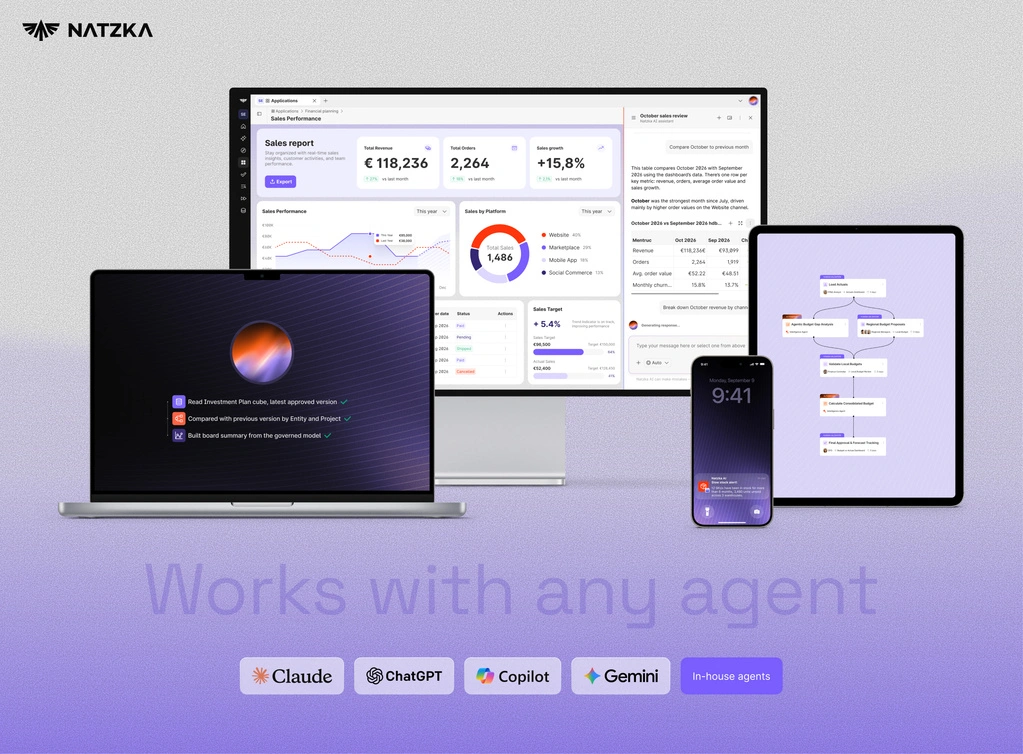
Natzka AI links AI to a company’s data, processes, business rules, and permissions. People can work in our own conversational interface. Alternatively, they can connect the AI models they already use through MCP (Model Context Protocol). MCP is an open standard for connecting AI models to external systems and data sources, now governed by the Linux Foundation’s Agentic AI Foundation.
Whichever route they choose, the answers draw on the same business rules and the same data. This matters most when a question cuts across sales, costs, and operations, because everyone then works from consistent numbers.
Human in the loop
Natzka AI does not take decisions out of people’s hands. Instead, it changes how quickly they can make them, and how much they can trust the information behind them. Teams then use the answers to weigh alternatives, spot critical issues, adjust plans, and coordinate actions. Where it makes sense, organisations can also configure agentic capabilities within boundaries they define.
Can AI make decisions on its own? Here’s a short Q&A video about Natzka AI.
Security and control built into the Enterprise AI Framework
Natzka AI follows the permissions set in the platform, whatever the interface or model. People only see the data their role allows, whether they work in our own interface or through a connected model. In addition, every answer shows the figures behind it, calculated with the organization’s own business rules. Users can therefore check the numbers before they act.
When a team connects its own model through MCP, that model receives only the results it queries for, within the user’s permissions. How the provider then handles that data depends on the provider and its configuration. For that reason, we recommend reviewing retention, training, and processing terms when choosing one. Agentic capabilities follow the same principle: organisations decide what AI can do and where a person reviews the result.
See the Enterprise AI Framework in action
To see how Natzka AI works with your own questions, request a demo or learn more about Natzka AI.