An AI answer becomes valuable when it helps someone make a better decision and act on it. For Enterprise AI, business context means understanding what the numbers mean, which rules apply and how work moves between people.
The Data Foundation First roundtable explored these foundations on 4 November at Politecnico di Milano. Andrea Masiero represented Natzka.

The research presented at the event shows why this matters. The Osservatorio Data & Decision Intelligence del Politecnico di Milano presented findings on Italian organisations. Among those covered by the research, 78% had started advanced analytics projects. Only 27% had mapped their decision-making and coordination processes with performance indicators and monitoring tools. Meanwhile, 31% had defined a structured data ontology.
These figures show how much work remains to connect analytics to explicit decision processes and a shared understanding of the data.
Business context makes data meaningful
A cost, a forecast or a sales figure can be interpreted differently across departments, even when everyone appears to be looking at the same data.
Consider a finance team investigating an unexpected increase in costs. Understanding what happened may require purchasing records, supplier terms, production plans and the rules used to allocate expenses. An AI system working with only part of that picture can produce an incomplete answer that sounds convincing.
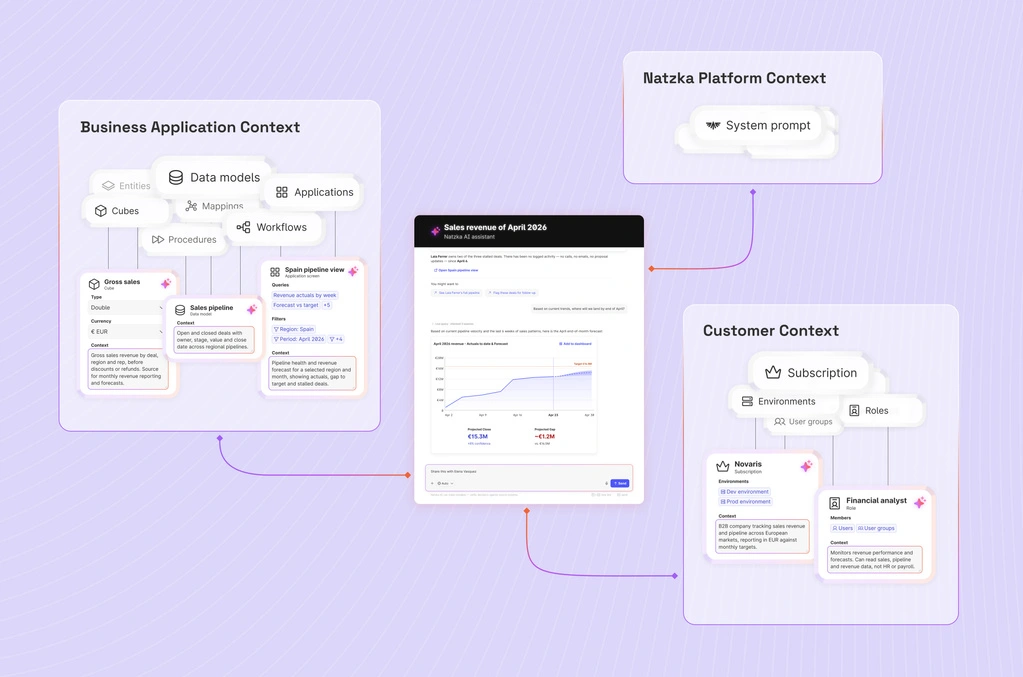
Our Decision Context Layer connects company data with the definitions, relationships and business logic needed to interpret it. Making that knowledge explicit gives people and AI a shared basis for understanding the business, including questions that cross departmental boundaries.
Putting the foundations to work with Natzka AI
Natzka AI, our Enterprise AI Framework, runs on the Natzka decision platform. People can ask questions in everyday language and check the figures behind the answers. They can then use the platform’s planning and workflows to move towards action. They can work through Natzka’s conversational interface or connect AI models they already use to the same business context.
In that cost review, the value extends to understanding the drivers, comparing possible responses, and coordinating next steps between finance, purchasing, and operations. The aim is to reduce the effort between identifying a problem and deciding how to address it.
Confidence also depends on control. The platform calculates figures using configured business rules, while access follows existing user permissions. Organisations define where AI supports a person, which tasks an agent can perform and when human approval is required.
Build around a real business decision
The same research found that 44% of companies that had identified critical decisions and defined decision rules used data systematically, compared with 5% of those without such rules. This association reinforces the importance of making decision processes explicit.
Building these foundations can start with a concrete business decision. Involving the people responsible from the outset helps identify the information, rules and workflows that matter, then creates a basis for extending the approach across other processes.
That is the business opportunity behind enterprise AI: putting useful capabilities in people’s hands, helping them reach informed decisions faster and giving those decisions a clear path to execution.
Request a demo to see Natzka AI with your own business questions.